

Date of Issue: July 10, 2023
Date of Last Amendment: December 30, 2023
I. EXECUTIVE SUMMARY
Purpose of the Manual– This manual (the “Manual”) is the primary reference document for the
Okanagan Aikikai and its Members. It articulates a set of core principles and a training framework that
guide our practice of Aikido. It also sets out the governance framework designed to ensure that the
Okanagan Aikikai optimally serves its membership and fulfills its purpose. This document is endorsed by
the Members of the Okanagan Aikikai and can be amended as necessary by its Members.
Guiding Principles– The Okanagan Aikikai is a not-for-profit organization whose primary purpose is to
facilitate the practice of Aikido for its Members. There are many “styles” of Aikido, and the Okanagan
Aikikai aligns with the technical curriculum of the Canadian Aikido Federation (CAF). In practicing Aikido
together, Okanagan Aikikai Members agree to adhere to a core set of principles such as safety, respect
and inclusiveness that underpin our collaborative approach.
Administration– The Okanagan Aikikai exists for its Members and its Members agree to support the
administration of the organization without remuneration. A Leadership Team, composed of five
memberselected by the Membership, spearheads the administration of the club. Following Japanese
martial arts traditions, a “Dojocho” heads the Leadership Team and oversees the technical aspects of
training.
Training– The Okanagan Aikikai focuses on providing a conducive training environment for its Members
to pursue Aikido training and to have opportunities for advancement in the CAF grading structure.
Senior Members share instruction responsibilities following the agreed guiding principles and training
curriculum.
II. INTRODUCTION
Purpose of the Manual– This manual (the “Manual”) is the primary reference document for the
Okanagan Aikikai (hereinafter referred to as the “Dojo”, the place of training) and its Members. It has
been prepared to serve three primary purposes. First, it articulates a set of core principles that guide the
practice of Aikido in the Dojo. These principles reflect the key values of the Dojo and should be shared
and understood by all Members. Second, the Manual sets out the governance framework with simple
guidelines designed to ensure that the Dojo optimally serves its membership and fulfills its purpose.
These guidelines serve as a transparent reference for the conduct of Members and Leadership in the
administration of the Dojo that eventually may be further formalized into By-laws1. Third, this Manual
lays out a basic framework for how Aikido will be practiced in the Dojo. It is intended to provide a
training structure for both Members and Instructors based on proven methods of teaching Aikido
without constraining flexibility and experimentation. However, this document is not a reference source
for Aikido “techniques”, which are extensively covered by numerous dedicated reference texts and
teaching materials.
Manual Organization– The Dojo Manual is organized into five main sections. It begins with a brief
background on the origins of Aikido as a martial art and the history of the Okanagan Aikikai as an
organization to promote the practice of Aikido in the Okanagan Valley. The second section articulates a
set of guiding principles that underpin the practice of Aikido as well as the administration of the Dojo.
The third section presents the governance framework chosen by the Dojo for its administration and
decision-making. The fourth section focuses on how the Dojo approaches the practice of Aikido and its
etiquette. The Manual also includes several annexes that provide a variety of useful templates and lists
covering areas such as membership forms, the Annual General Meeting, and the training cycle.
Acknowledgments– This Manual is the result of a collective effort by senior Dojo Members to codify
practices and enhance our institutional memory. It has benefitted from guidance and input from several
Aikido experts in particular Pat Olson, Yumi Nakamura, Jim Barnes, Ivan Booth and Bruce Riddick. The
Manual is a “living” document and will be amended and improved from time to time to reflect the
evolution of Aikido, the Dojo and the practices of its affiliated entities2.
Acknowledgments– This Manual is the result of a collective effort by senior Dojo Members to codify practices and enhance our institutional memory. It has benefitted from guidance and input from several Aikido experts in particular Pat Olson, Yumi Nakamura, Jim Barnes, Ivan Booth and Bruce Riddick. The Manual is a “living” document and will be amended and improved from time to time to reflect the evolution of Aikido, the Dojo and the practices of its affiliated entities2
III. BACKGOUND
Origins of Aikido– Aikido was developed in Japan by Morihei Ueshiba (1883–1969), as a synthesis of
his martial studies, philosophy and spiritual beliefs. Also known as “Osensei” (great teacher), Ueshiba’s
goal was to create an art that practitioners could use to defend themselves while also protecting their
attackers from injury. Aikido is often translated as “the way of unifying (with) life energy” or as “the way
of harmonious spirit”. According to the founder’s philosophy, the primary goal in the practice of aikido is
to overcome oneself instead of cultivating violence or aggressiveness.
1 The Avalon Aikikai in New Foundland has a formal set of By-laws that provide a template for the future.
2 The 2024 amendments primarily include the addition of a complaints procedure, the requirement for regular
instructors to complete a police background check, and criteria for voting rights at the AGM.
3 Copied from and inspired by Wikipedia
Aikido’s fundamental technical principles include: irimi (entering), atemi (strikes for distraction), kokyu
ho (breathing control), sankaku-ho (triangular principle) and tenkan (turning movements that redirect
the opponent’s attack momentum). Its curriculum comprises various techniques such as throws, joint
locks and pins. It also includes a weapons system encompassing the bokken (wooden
sword), tantō (wooden knife) and jō (short staff).
Today, aikido is found all over the world in various styles, with broad ranges of interpretation and
emphasis. However, they all share techniques formulated by Ueshiba and most have concern for the
well-being of the attacker. The largest aikido organization is the Aikikai Foundation (the Aikikai), which is
headquartered in Japan. The Canadian Aikido Federation (CAF), which is the largest federation of Aikido
practitioners in Canada, is directly affiliated with the Aikikai and its international network, the
International Aikido Federation (IAF).
Brief History of the Okanagan Aikikai– The Okanagan Aikikai was established in Kelowna, British
Columbia in 1986 by Yukio Kawahara (1940– 2011), the top Aikido Shihan (Master Teacher) in Canada at
that time. The Dojo was formed to offer residents of the Okanagan Valley and visitors to the region the
opportunity to learn and practice Aikido, stressing the growth of Mind, Body and Spirit. Given its
location relative to the province’s largest urban centers, the Okanagan Aikikai is considered a “remote
dojo” under CAF rules.
In addition to the leadership of Kawahara Shihan, the Dojo has benefited from the guidance of several
Sensei (teachers) starting with Jobe Groot (6th Dan) who was sent by Kawahara Shihan to lead the club in
its early years, Peter Helmer (5th Dan) who led the opening of a training site in Vernon, and Jim Redding
(3rd Dan) who opened a site in Summerland. Pat Olson (6th Dan) led the Dojo until her departure in 2023.
Both Pat Olsen and Peter Helmer have been awarded the honorary title of “Shidoin” by the CAF.
Through the Canadian Aikido Federation, the Okanagan Aikikai is affiliated with the Aikikai
headquartered in Japan. It is also registered with the British Columbia Aikido Federation (BCAF), the
provincial body. Thanks to diligent leadership in the past, the Dojo is recognized as a center of Aikido
excellence and has regularly hosted CAF seminars that attract Aikido teachers and practitioners from
across Canada and abroad. The Dojo continues to benefit from the legacy of past leadership and takes
guidance from their designated successors.
IV. Guiding Principles
- The activities of the Dojo are guided by a few core principles that reflect the central values of its
Members. The main principles are: - Purpose– The Dojo exists to enable its Members to pursue training in Aikido in a convivial, collaborative and safe environment.
- Safety– Aikido is a martial art and therefore entails inherent risks of injury. However, the Dojo always puts the safety of its Members first, with the objective of avoiding training-related injuries. More “robust” training is acceptable between adequately qualified and consenting Members, who assume responsibility for injuries that may inadvertently occur. The Dojo maintains CAF insurance cover for unexpected training accidents.
- Hygiene– Aikido training creates close proximity and contact between multiple partners. Members are mindful of the risk of transmission of diseases and take appropriate precautions. Members are also conscious of the standards for clean training clothing and personal hygiene related to hair and nails.
- Respect– Aikido training is most often performed with one or more partners that collaborate to help each other progress in the physical, mental and spiritual aspects of the art. Members will always be respectful of each other and follow instructions given by Dojo leadership. Failure to adhere to Dojo leadership instructions may lead to temporary or permanent expulsion.
- Inclusiveness– Subject to specific limitations, membership in the Dojo is open to people from all walks of life as diversity enriches the Aikido experience for all Dojo members. The Dojo encourages young students and their parents / guardians to learn and explore Aikido together. However, all Members agree to abide by the principles of the Dojo regardless of their age, gender, disability, race or religion. Members from other Aikido dojos as well as practitioners of other styles of Aikido or other martial arts are welcome to train at the Dojo as guests and are also expected to follow Dojo rules.
- Seniority– Aikido has a traditional grading system promulgated by the CAF that reflects a combination of technical mastery, experience, and contribution to the art. Members of the Dojo will respect the seniority implied by this grading system (sempai/kohai). At the most basic level this means junior members will be open to guidance and more senior members will generously provide coaching and instruction. All Members will adhere to decisions taken by the appointed Leadership Team.
- Pedagogy– Training in the Dojo focuses on traditional Aikido and its related grading system as promulgated by the CAF. Instruction seeks to allow Members to be exposed to the full breadth of Aikido techniques using proven training methods and to have the opportunity to test and progress through the grading hierarchy. The Dojo also aims to give Members the opportunity to train under different qualified Instructors and to encourage senior Members to develop teaching skills.
- Excellence– The Dojo strives to be a center of Aikido excellence and leadership in promoting Aikido both locally and outside the region. The Dojo will endeavor to regularly organize training seminars that bring together teachers and practitioners to exchange experiences and strengthen collaboration.
- Gratitude– The Dojo recognizes the vision and role played by Osensei to create and share Aikido as well as the role of the Dojo’s founders. Members acknowledge this gift and express appreciation by honouring Aikido traditions. Members express appreciation and gratitude to other Members with whom they are privileged to train and learn.
- Sustainability– The Dojo does not seek to maximize profits. However, the Dojo’s activities will be guided by the need for both financial and environmental sustainability. There is no tolerance for impropriety in the handling of the Dojo’s financial matters.
V. DOJO GOVERRNANCE
i. DEFINITIONS
For the purpose of this Manual, the following definitions of key governance terms apply:
Dojo– A dojo is the general Japanese martial arts term for the “place to train in the way of the art”. For
the purpose of this Manual, “the Dojo” refers to the Okanagan Aikikai and all its directly affiliated
entities and training facilities.
Active Members– The Dojo exists primarily to serve the expectations of its Active Members. Active
Members have met all Membership Requirements and are current on all Membership Dues to the Dojo 4.
All Active Members age 16 or above that have paid dues for at least 3 months prior will have one vote
on matters put before the Dojo’s Annual General Meeting (AGM).
Young Members– Young Members are Active Members under the age of16 but above 8 years old 5. Young Members may attend the AGM but will not vote.
Non-Active Members– Non-Active Members are persons that may have previously but no longer meet
all requirements to be Active Members (e.g. not paying membership dues). Non-Active Members may
attend the AGM ofthe Dojo but will not have any voting rights. Non-Active Members will not participate
in regular training activities.
Ex-Members– In exceptional circumstances, failure to adhere to Dojo rules and principles or engagement in criminal behavior may cause Dojo Leadership to revoke Membership. Ex-Members will not participate in any Dojo activities.
Membership Requirements– All Active Members of the Dojo will complete the prevailing membership forms (see Annex 1) and ensure that the information contained in the Dojo’s membership records is correct and current. Members must also complete the CAF waiver to qualify for CAF insurance covering training accidents. The Dojo has no maximum age but applies a minimum age of 8 years for Members. Applicants under the age of 16 years require parental authorization to become Members.
Membership Dues– All Active Members will pay the Dojo’s monthly Membership Dues as determined from time to time by the Dojo Leadership Team. The preferred mode of payment is via e-transfer to the Dojo’s account: okanaganaikido@outlook.com. All Active members will also pay the annual membership fees for the CAF and BCAF. The Dojo will remit these fees annually to the CAF and BCAF on behalf of Active Members and update their respective membership databases. Active Members that incur arrears on Dues in excess of 3 months become Non-Active Members, except as waived by the Leadership Team.
Guests– The Dojo welcomes guests to train with Dojo Members. Typically, guests include members from other Aikido clubs who are visiting the Okanagan or individuals interested in trying out Aikido. All guests must complete a liability waiver and pay a drop-in fee, except as waived by the Leadership Team.
Leadership Team– Day to day governance of the Dojo is provided by the Leadership Team. The Leadership Team is composed of five Regular Leadership Members who are appointed by the Active
4 This includes registration and annual dues paid by the Dojo on behalf of all Members to the CAF and BCAF.
5 The Parents or Guardians of Young Members are expected to provide transportation to and from the Dojo and to supervise Young Members while in the Dojo as appropriate.
Members at the AGM to take day today decisions on behalf of the Dojo. Members of the Leadership
Team perform their duties to the best of their abilities to serve the interests of the Dojo without
financial remuneration.
Regular Leadership Members– Regular Leadership Members form the core of the Dojo Leadership Team and are collectively responsible for the overall day to day governance of the Dojo. Regular Leadership Members are appointed by the Active Members. Each Regular Leadership Member has a
specific set of responsibilities that may be adjusted from time to time subject to normal Leadership Team decision-making rules. Regular Leadership Members should be 16 or older. Leadership Team positions that do not require Aikido experience may be filled by qualified individuals that are not Aikido practitioners themselves. For example, parents of Young Members could serve on the Leadership Team.
Dojocho– Reflecting Aikido and general Martial Arts traditions, the Dojo will appoint a Dojocho (the Japanese term for the head of the dojo). The Dojocho is the Chief Instructor, the head of the Dojo Leadership Team and has special duties as specified in this document that reflect CAF guidance and protocols. The Dojocho may delegate the authority of the Dojocho to the Deputy Dojocho.
Ad-Hoc Leadership Members– The Dojo Leadership Team may appoint Ad-Hoc Leadership Members, usually to advise or oversee specific tasks. Ad-Hoc Leadership Members are nominated subject to normal Leadership Team decision-making rules. Ad-Hoc Leadership Members are “ex-officio” and therefore do not have Leadership Team voting rights.
Annual General Meeting– The highest decision-making organ of the Dojo is the Annual General Meeting (AGM). The AGM is held once each year on a date and place as determined by the Leadership Team(See Annex 2)
ii. LEADERSHIP TEAM
The Dojo Leadership Team is composed of five Regular Members with primary roles and responsibilities as follows:
Dojocho- Following Aikido and Martial Arts traditions, the Dojocho is responsible for overall leadership of the Dojo including performing the role of “chief instructor”. The Dojocho heads the Leadership Team and is “the face of the Dojo” with other organizations. Some of the primary responsibilities of the Dojocho include:
- Setting the training curriculum
- Setting the teaching assignments
- Setting Dojo etiquette
- Proposing and over seeing Members’ Kyu-grading
- Proposing Members for Dan-grading to the CAF and attending Members’ Dan-grading sessions
- Representing the Dojo at CAF and BCAF events
- Convening and chairing Leadership Team meetings
- Convening and chairing the AGM
- Recruiting Leadership Team Members
- Preparing strategic plans for Dojo growth and development including other tasks related
- to establishing the class structure, content and training environment of the Dojo, as required
- Proposing updates to the Dojo Manual
Secretary (and Deputy Dojocho)– The Leadership Team Secretary is also the Deputy Dojocho and will temporarily assume this role if/when the Dojocho is unable. The Secretary supports the Dojocho to administer the Leadership Team, maintain records, and coordinate official correspondence. The secretary represents the Dojo at events and meetings when the Dojocho is unavailable. Some of the primary responsibilities of the Secretary include:
- Acting as Deputy Dojocho
- Coordinating activities of the Leadership Team
- Preparing official Dojo correspondence
- Maintaining official Dojo records including Minutes of Meetings
- Maintaining the list of all Active and Non-Active Members and relevant information
- Submitting Dojo paperwork to relevant authorities
- Managing insurance through the CAF and other sources and managing insurance claims
- Organizing the AGM
- Maintaining records of Members’ grading and promotion schedules
- Submitting Kyu-grading and Dan-grading paperwork to CAF
Treasurer– The Treasurer provides leadership in all Dojo financial management matters and will allow the books and financial accounts to be reviewed by the Leadership Team at its discretion. Some of the primary responsibilities of the Treasurer include:
- Preparing an annual budget
- Setting and collecting membership dues
- Paying bills
- Managing bank balances
- Preparing an annual financial report
Operations Officer– The Operations Officer takes the lead to ensure adequate training facilities for regular practice as well as leading the organization of seminars. Some of the primary responsibilities of the Operations Officer include:
- Identifying and maintaining training facilities
- Negotiating rental agreements for training facilities
- Ordering and maintaining equipment and training gear (e.g. Mats, Weapons, Uniforms)
- Organizing local seminars and acting as Yudansha test coordinator at hosted events
Communications Officer– The Communications Officer plays the lead role ensuring effective
information sharing within Dojo Membership and with the Public. Some of the primary responsibilities of the Communications Officer include:
- Managing the website and other social media
- Preparing outgoing communications for Dojo announcements
- Relaying incoming communications to Dojo Members
- Leading Dojo promotional activities including membership drives
iii. APPOINTMENTS AND DECISION MAKING
Leadership Appointments– All Dojo leadership appointments are made by majority decision of the
AGM. There are no term limits for Regular Members of the Leadership Team. Appointments are
voluntary and Regular Members may resign at any time. Members of the Leadership Team will not
normally hold more than one position at a time.
Interim Leadership Appointments– If for any reason there is a vacancy among the Leadership Team, the remaining Leadership Team Members will appoint an Interim Leadership Member until a new Regular Leadership Member can be confirmed at the next AGM.
Removal of Leadership Appointments– Regular Members of the Leadership Team can be removed from duty by a two-thirds majority decision of the AGM. Pending a formal decision of the next AGM, Regular Members of the Leadership Team can be suspended from duty by a majority decision of the other Regular Members of the Leadership Team.
Leadership Team Meetings– Any Member of the Leadership Team may request the Dojocho to convene a meeting. All formal Dojo decisions are taken at Leadership Team Meetings. Where formal decisions are proposed, Members will be notified by the Secretary at least 1 week in advance of the meeting. Leadership Team meetings may be in person, virtual or some combination. Concise records will be kept of all Leadership Team meetings with a focus on decisions taken.
Dojo Leadership Decisions– Under the chairmanship of the Dojocho, the Dojo Leadership Team will seek to find consensus on all Dojo matters for decision. At least three Regular Leadership Members shall constitute a quorum for formal decisions. In exceptional cases where a consensus cannot be reached, decisions will be taken by open vote subject to a simple majority ruling. In such cases each member of
the Leadership Team, including the Dojocho, will have one vote.
Annual General Meeting Decisions– All Active Members age 16 or older that have paid dues for at least3 months prior have one vote on matters for decision at the AGM. The Leadership Team will table all decisions for the AGM and inform all Active Members at least 2 weeks prior to the scheduled meeting. At least 25% of all Active Members shall constitute a quorum for formal AGM decisions.
iv. RECORD-KEEPING
Leadership Team Meetings– The Secretary will prepare a concise minute of each Leadership Team meeting that records attendance, the decisions taken and any other relevant information. Minutes of Leadership Team meetings will be validated by the Leadership Team and archived. As necessary, decisions will be promptly communicated to Active Members.
Annual General Meetings– The Secretary will prepare a minute of each AGM that records attendance and compliance with quorum rules, the decisions taken, and any other relevant information. Minutes of the AGM will be validated by the Leadership Team for accuracy and completeness and archived. All Active Members will be informed of decisions taken at the AGM within 2 weeks of the meeting. Annex 2 presents an indicative template for the agenda and the reports to be discussed at the AGM
v. COMPLAINTS
There may be occasions when a Member or a Non-Member complains about matters relating to functioning of the Dojo or the behaviour of one or more of its Members. The Dojo allows for these kinds complaints to be considered and appropriate actions to be taken. However, complaints that do not relate directly to the Dojo’s activities fall outside of the scope of these procedures. For example, complaints about a Member’s behavior outside of the Dojo would not be considered under this guideline.
The Leadership Team is responsible for receiving, considering and responding to complaints. All complaints shall be directed through at least one member of the Leadership Team either verbally or in writing. In general, the Leadership Team will attempt to resolve the complaint through informal discussions with the parties. If requested by the complainant, the Leadership Team will provide a written response on the complaint. The Leadership Team will consider the complaint as early as possible and record its decision in the minutes of its meetings. The complainant or the person subject to the complaint may appeal the decisions of the Leadership Team once. After considering any appeal, the decision of the Leadership Team shall be considered final and binding.
vi. UPDATING THE MANUAL
Amendments– This Manual may be amended and updated from time to time. The Dojo Leadership Team will propose amendments for decision by the Annual General Meeting.
VI. TECHNICAL APPROACH
Objective– The purpose of this section of the Manual is to provide clarity to Members and Instructors on avariety of aspects relating to the practice of Aikido by the Dojo. It is a brief reference for the main concepts, practices and methods that the Dojo and its Members agree to follow. But it is not a source of information on how to perform Aikido techniques, for which there are many articles, books, videos and most importantly instructors who possess in-depth knowledge and experience.
i. Definitions
For the purpose of this Manual, the following definitions of key technical terms apply:
Training Place– A dojo is the general Japanese martial arts term for the “place to train in the way of the art”. The term “dojo” is also used to describe a martial arts organization or club. This Manual refers to the place where training is done as the “training place (s)”.
Grading System– The Dojo adheres to the grading system used by the CAF, which is based on a combination of technical mastery, time in training, and contribution to the art. The CAF technical policy articulates the standards, requirements and procedures for testing.
Mudansha– Denotes practitioners of Aikido that have not yet achieved the grade of Shodan (1st degree black belt) or above. All beginners regardless of age are Mudansha. The CAF grading system articulates different levels of Mudansha using the term “kyu”. Typically, all Aikido Mudansha wear a white belt, regardless of “kyu”.
Yudansha– Denotes practitioners of Aikido that have already reached the grade of Shodan (1st degree black belt) or above. Mudansha (white belts) progress to become Yudansha (black belts) after successfully achieving the grade of Shodan. Through the CAF, Yudansha receive a booklet (Aikido Passport) that contains their ranking history and can be used to record seminar attendance.
CAF Examination Committee– The CAF empowers its Examination Committee to oversee all official testing and Aikido grading activities for CAF members in Canada. As a CAF requirement, all Yudansha testing must be done under the oversight of the Examination Committee, subject to certain exceptions. The CAF delegates authority for Mudansha testing to qualified Instructors in each Aikido organization. The results of all Mudansha testing are registered through the CAF, which keeps a comprehensive database of the grading history of all registered Canadian Aikido practitioners and monitors compliance with the prevailing standards and rules.
RemoteDojo– The CAF recognizes that Aikido is practiced outside of the major urban centers, which makes access to testing by its Examination Committee more difficult and expensive. The CAF allows exceptions for Yudansha testing for Members of “remote dojos”, such as the Okanagan Aikikai, where a qualified “Shidoin” shall be present.
Shidoin– The honorific term used by the CAF to recognize the experience of expert Instructors and empowers themto exceptionally oversee certain Yudansha testing in remote dojos. Instructors– For the purpose of this Manual, the term “Instructor” denotes anybody designated by the Dojocho to lead training7. The Dojocho is also the “Chief Instructor”. Normally, Instructors will be Yudansha Members (Shodan or above)but exceptionally Mudansha may be designated to lead specific training sessions by the Dojocho. The Dojocho sets the teaching assignments among Instructors taking into consideration various factors such as the curriculum as well as Instructor experience and availability. 6 See CAF website for details of the Examination Committee and its role (https://canadianaikidofederation.ca/)
7 The Dojo will conform with CAF rules for Instructors including amongst others any required police check. Instructors from outside the Dojo (non-Members) may be invited with agreement of the Dojocho to lead training.
ii. TRAINIING FACILITIES
Training Place– The Dojo does not own a property or a building where training is held. Instead it relies on leased, rented or free facilities to enable Aikido practice. For example, in the past the Dojo has paid to share facilities with the Kelowna Judo Club or rented space in a Church for indoor training. The Dojo has used public areas such as Ben Lee Park for outdoor weapons training. The Dojo has rented gym space in a school or a university to host seminars if the number of practitioners is too large for the regular training facility.
Selection of Training Places– Selection of training places is the responsibility of the Dojo Leadership Team. The Operations Officer takes the lead to identify and negotiate appropriate new training places whenever required. The Treasurer provides guidance on the financial aspects. The Dojo looks for
training places that have the appropriate combination of available training space, training times, training surface, storage space (for mats and weapons), washrooms, changing rooms, climate control, hygiene, security, availability and cost.
Maintenance of Training Places– The Dojo aims to provide Members with appropriate training places and Members are expected to contribute to the maintenance and cleanliness of Dojo facilities. This is an important part of Aikido tradition. Training places will be treated with respect and Members will avoid any intentional damage. Members will immediately report any inadvertent damage caused through training or other actions. Members will participate in regular cleaning activities to ensure all training places meet the appropriate standards of hygiene. The Operations Officer takes the lead to coordinate the Dojo’s participation in the maintenance of training places and Dojo Instructors provide direction to Members on cleaning requirements during training sessions.
Training Equipment– The practice of Aikido requires several pieces of “shared” equipment such as mats or weapons as well as “personal” items such as training uniforms (Keikogi). Dojo Members treat all forms of equipment will due respect and care.
Mats–Proper practice of Aikido requires a soft hygienic surface to enable safe throwing and rolling. Traditional martial arts facilities have “tatami” mats whereas other clubs use more modern mats that are either left in place or removed after practice. The Dojo has owned mats that it uses if its rented training facilities do not provide an appropriate training surface. When not in use, these mats must be stored in a secure, clean and dry location.
Regalia– In line with the traditions of Aikido, the Dojo uses a number of items to show respect and gratitude during training. For example, whenever possible during training the Dojo displays a likeness of the founder of Aikido, Osensei Morihei Ueshiba, generally at the front of the training area. Similarly, the Dojo displays a likeness of the founder of the Okanagan Aikikai, Yukio Kawahara Shihan, during training. The Dojo may also display other forms of “Shomen” during training or seminars. All items of Dojo regalia are stored in a secure, clean and dry location when not in use.
Weapons– Aikido training involves three main types of weapons (Bokken, Tanto and Jo). The Dojo owns a number of each type of weapon and some Members own their own weapons. During training weapons are treated with respect using protocols aligned to Aikido traditions. Dojo Instructors teach Members these protocols and Members are expected to follow them. All Dojo weapons are stored in a secure, clean and dry location when not in use.
Training Uniforms– Aikido is usually practiced wearing standard martial arts uniforms (Keikogi). A variety of styles are acceptable by the Dojo but the colour is normally predominantly white. Members are expected to provide their own uniforms and to ensure that they remain in good condition including regular washing. Members should avoid wearing other garments (e.g. t-shirts under their Keikogi with the exception of female students), in the Aikido tradition. Also, jewelry, including rings, piercings, and bracelets should be avoided for safety reasons.
Belts– Most martial arts training uniforms come with a white belt when purchased. Members use the white belt while they are Mudansha (prior to Shodan). After promotion to Yudansha (Shodan and above), Members receive a black belt, which is worn in training instead of the white belt. The transition to black belt is marks a key milestone in the progression of Aikido training.
Hakama–A hakama is a black or blue traditional Japanese form of outer pants. Some Japanese martial arts, including Aikido, include the hakama as part of the normal training uniform. In line with Aikido traditions, Dojo Members are expected to purchase and wear a hakama once they become Yudansha. Female Mudansha may wear hakama at their discretion, except that only Yudansha will wear a hakamaat CAF seminar events. Members are expected to treat the hakama with respect and care by tying it correctly during training and folding it correctly afterwards.
Towel– Aikido training is physical and often causes practitioners to perspire. Out of respect for training partners and general hygiene, Members are expected to carry a small hand towel during training to periodically wipe off sweat
iii. ETIQUETTE
Objectives– The Dojo follows standard practices of Aikido etiquette as promulgated by the CAF. These practices are underpinned by a desire to show respect and gratitude to the founders and teachers of Aikido, and to the training partners and places that make practice and progression possible. The Dojocho takes the lead to set Dojo etiquette standards, which are transmitted through Instructors and Members. The guidance below is a summary of key points of etiquette rather than exhaustive. As is the tradition of most martial arts, the customs of etiquette are acquired through mindful practice and observation.
Entering and Leaving the Training Place– The place where training is done provides Members the opportunity to practice and progress. Members will symbolically bow to the Shomen to acknowledge the importance of the training place when entering and leaving. Members will also symbolically bow
when entering and leaving the training area (the mats). Shoes or sandals are not worn on the training area and are left at the side of the mats, arranged neatly facing away from the mats. Members walk in the training area either in clean bare feet or wearing clean socks. Orientation of the Training Area– Aikido traditions require that each training area has a designated “front” (Shomen) where regalia such as the likeness of the Founders are placed either temporarily for each training session or left in place depending on specific circumstances. This orientation is used to guide various etiquette practices.
Before and After Each Training Session– The Instructor calls each training session to begin and to finish. Members should endeavor to be on the training area a few minutes before the designated training time to allow for a punctual start to training. At the start and finish of each training session Members line up in a kneeling position (Seiza) facing towards the designated Shomen of the training area. The Instructor kneels between the line of Members and the Shomen. Following a short period of “Mokuso” (mediation), the instructor calls for kneeling bows towards the Shomen and facing each other.
Arriving Late– If Members are unable to arrive before a training session has started, they will wait for permission from the Instructor before entering the training area. They will then perform the standard bowing etiquette on their own, warm up without interfering with the on-going class, and then quickly and quietly integrate into the class.
Leaving Early– If Members need to leave the training area before the end of the training session (e.g. to leave the training facility or to use the washroom or drink), they will notify the Instructor and perform the standard exit bowing etiquette on their own. Members leaving early will try to exit quietly with the least disturbance to the class.
Instructors– Instructors and Members always treat each other with respect and courtesy. Instructors are designated to lead training by the Dojocho and perform an important role teaching and ensuring the safety of all Members. In line with CAF policy, all regular Instructors must complete a policy check. Members will follow the instructions provided by Instructors, regardless of rank
iv. CURRICULUM
Objectives– The Dojo establishes its core curriculum to allow its Members to be exposed to the breadthand richness of Aikido forms and techniques. The Dojo has chosen a structured “training cycle” approach that facilitates steady progression by Members of all levels and ages. Although there are many “styles” of Aikido that have evolved as Aikido has spread and grown globally, the Dojo focuses its training curriculum on standard Aikido as promulgated by the CAF while leaving flexibility for experimentation outside the core syllabus by senior Members. The Dojocho has primary responsibility for setting and overseeing the implementation of the curriculum.
Training Cycle– The Dojo’s Aikido practice is organized into three 4-month training cycles each year. Each 4-month training cycle is designed to enable Members to progress through the range of Aikido techniques of different complexity and to finish each cycle with an opportunity to evaluate progress through testing in the Aikido grading system. To facilitate grading for senior students (Yudansha), whichmust be done under the oversight of the CAF Examination Committee, the Dojo tries to align its Training Cycle with the two main annual CAF events as follows:
March–June(CAFSummerCamp)
July–October (CAFFall Seminar)
November-February(Currently no scheduled CAF event)
Weekly Program– Within each four-month training cycle, the Aikido curriculum is divided into 16 (17) weekly increments usually composed of two or three training sessions per week8. During each week, training generally covers a range of techniques against a single specific attack (e.g. shomenuchi) or category (e.g. tantodori), which will change weekly according to a prescribed schedule each training cycle (see Annex 2 for a sample of the weekly program for each training cycle). Members will be informed of the weekly program for each training cycle.
Training Session– the Dojo seeks to offer Members two or three 1.5– 2 hours training sessions each week throughout the training cycle. Normally, the first training session in each week focuses on the “core techniques” recommended by the CAF. Training sessions later in the week may include other
techniques and variations. Time permitting, each training session will be divided into two parts: 1) Group training session; 2) Individual training session.
Group Training Session– The first part of each training session (usually 1 hour) is usually reserved for group training where all Members practice together. The group session starts with a basic warm-up and stretching routine. It may include exercises that train basic Aikido movements as well as proper breathing and is followed by practice of a selection of Aikido techniques. The Instructor chooses the mix of exercises and techniques in line with the weekly program each training cycle. During group training, senior and junior Members mix and help each other in a spirit of collaboration.
Individual Training Session– The second part of each training session is usually reserved for more individualized training programs. During the second part of each session the instructor forms smaller groups that usually focus on specific mutual training objectives. For example, Members preparing for
testing and grading may focus on their testing requirements. Younger Members may use the individualized training session to focus on reviewing basics. Senior Members may focus on more advanced techniques.
Weapons Training- Aikido training involves three main types of weapons (Bokken, Tanto and Jo). There are a variety of forms of weapons training such as katas (a sequence of movements by an individual alone), partner practice (two or more people each using weapons in prescribed sequences), or
takeaways (removing a weapon from an armed attacker). The Dojo includes weapons training as a regular part of practice usually during the individual training sessions or as the focus of dedicated outdoor weapons practice sessions. Senior students are expected to provide their own weapons.
Young Members– The Dojo encourages Young Members to pursue Aikido. Some Young Members may attend training sessions with their parent(s) who may be Regular Members. The curriculum at each training session will give due consideration to the mix of Young Members in attendance. Where possible, Young Members will be encouraged to follow the curriculum of the Dojo with other Regular Members. Where preferable, training will be customized for the needs of the Young Members.
Dedicated Training for Young Members– Currently the Dojo does not offer dedicated training sessions for Young Members. However, the Dojo is aware that other Aikido organizations have benefitted tremendously from expanding training opportunities for children and youth. The Leadership Team will assess the feasibility of developing a dedicated training program for Young Members. 8 This training frequency allows Members the opportunity to progress while keeping within the Dojo’s financial budget
Teaching Assignments– An Instructor will be designated for each training session. The Dojocho has
primary responsibility for setting the teaching assignments of Instructors.
Communication– The curriculum and teaching assignments will be regularly communicated to
Members along with any changes to training times and locations. The Communications Officer has
primary responsibility for regularly disseminating pertinent information on the website and through
communications media such as e-mail.
v. TESTING AND GRADING
Testing and Grading– Like most martial arts, Aikido applies a system for evaluating and acknowledgingthe progress of its practitioners. The Dojo follows the testing and grading rules of the CAF, which arebased on Aikikai standards. Testing and grading allow Members to gauge their progress against objective benchmarks and motivates training towards specific goals. It enables Instructors to assess Members’ progress and fine-tune training programs. And it provides objective feedback on the overall progression of the Dojo both internally and externally.
Testing Frequency– the Dojo aims to organize testing for Members three times each year, generally at the end of each 4-month training cycle. For Mudansha (prior to Shodan), testing usually takes place at the Dojo’s training location under the oversight of the Dojocho supported by an examination panel of other Instructors designated by the Dojocho. In line with CAF protocols, testing for Yudansha (Shodan and above) will take place at a formal testing session during an authorized CAF Camp or Seminar. Generally, the CAF requires either the Dojocho or Deputy Dojocho to attend events where Dojo Yudansha Members are testing.
Testing Obligations– Testing and grading for Dojo Members is recommended but is not mandatory. No Members will be compelled to test.
Testing Requirements– The CAF has codified a comprehensive list of testing requirements for each Mudansha and Yudansha grade. Requirements for each grade generally include a prescribed list of techniques as well as specific minimum training times since promotion from the previous grade. Each grade will also generally have different expectations for other aspects such as fluidity, posture, situational awareness, energy of execution, distance management, confidence, etc. CAF testing requirements change from time to time and are posted on the Dojo website as a reference for
Instructors and Members.
Testing Schedule– The Dojo will record the grading history of all Members. The Secretary has primary responsibility for managing the grading database. Members will be notified when they are projected to meet grading requirements and will be encouraged to apply for testing on the prescribed testing dates. The Dojocho makes the final decision about which Members may test at each testing event. For Yudansha testing, the CAF requires that the Dojocho submits a request for testing through the proper channels.
Testing Results– It is generally expected that Members who are deemed ready for testing will be able to successfully pass. However, for a variety of reasons, some Members may not pass a test on a given day. All Members who test will be given constructive feedback on the test as well as areas for future improvement. The Dojo encourages all of its Members to progress through the Aikido grading system Testing Fees– Members who test must pay the prescribed testing fees prior to testing. Dojo testing fees are periodically set by the Leadership Team to cover the cost of CAF testing fees and any other costs deemed relevant. The costs of purchasing a black belt and a hakama for Yudansha successfully grading
to Shodan are generally not covered in the testing fees. The Leadership Team may decide to waive testing fees and other related costs if doing so does not endanger the financial sustainability of the Dojo
ANNEX2–ANNUALGENERALMEETINGS
Overview– The Dojo will hold an Annual General Meeting each year to exchange information and take decisions. AGM decision focus on matters that are beyond the delegated authority of the Leadership Team. This includes but is not limited to decisions relating to appointments of Regular Leadership Team Members.
Agenda– The AGM agenda will be proposed by the Secretary after consultation with the Leadership Team. Regular agenda items could include reports on:
- Minutes of the previous meeting
- Training attendance
- Training Curriculum
- Grading and Promotions
- Logistics including training facilities
- Announcements from the CAF and BCAF
- Financial matters
- Goals and budget for the coming year
- Other Dojo news
Notification- The Secretary with assistance from the Communications Officer will ensure Members are informed about items for decision at least 2 weeks before the meeting. Members should try to submit questions or comments to the Dojocho one week prior to the meeting, to provide time to complete any required research to properly address all questions.
Attendance– All Active Members are encouraged to participate in the Dojo AGM and have voting rights on AGM decisions provided they have paid dues for at least 3 months prior to the AGM. They may attend in person or virtually. Active members that are unable to attend the AGM may vote by proxy by sending the proxy vote to the Secretary. Non-Active Members may attend the AGM as observers and contribute to the discussions. Non-Active Members will not participate in decisions taken through vote. Other people, such as parents of Young Members, may attend the AGM with the prior agreement of the Leadership Team and exercise a proxy vote for their child.
Quorum– For voting decisions, the AGM quorum is at least 25% of all Active Members. Proxy votes count towards the quorum requirement
ANNEX3–TRAININGCYCLES
Overview– The Dojo applies the “training cycle” concept for its curriculum to enable Members to experience the richness of Aikido and progress in their training. Each training cycle lasts for four months and is repeated three times per year. The curriculum in each training cycle follows a basic 16-week framework that progresses from basic to more complex. This framework is indicative and may be adjusted based on factors such as holiday periods, regional seminars and testing priorities.
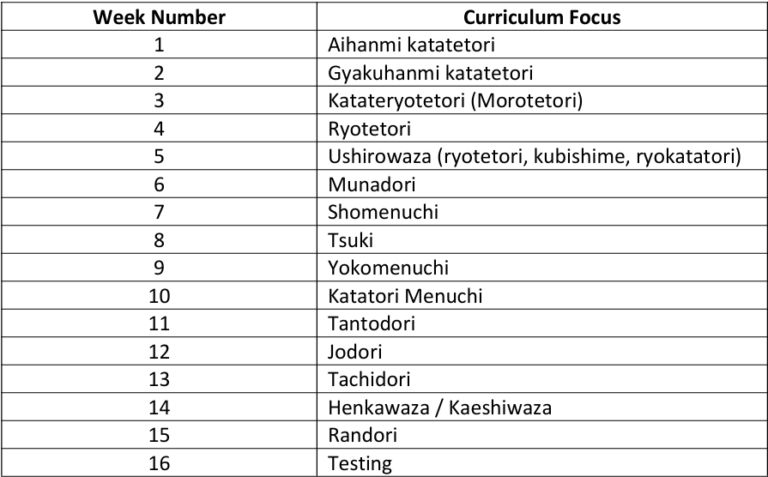
Testing- To enable Members to have a regular opportunity for grading progression, there is a testing event at the end of each training cycle. For Yudansha, who are generally required to be tested by the CAF Examination Committee, the training cycle will be synchronized whenever possible to end with the two main CAF testing events (e.g. Summer Camp, Fall seminar) and any regional events. In exceptional cases, ad-hoc Yudansha testing events may be scheduled by the Dojocho in accordance with CAF rules. For Mudansha, who maybe tested under the oversight of the Dojocho (or the Deputy Dojocho when delegated), there will be a local testing event scheduled at the end of each training cycle.
Weekly Plan– There are generally two or three training sessions each week. The first training session of each week will generally focus on CAF “core” techniques during the time reserved for group training. Training sessions later in the week may include other techniques in the group training part.
Suwariwaza– Techniques executed from the kneeling position (suwariwaza or hanmi-handachiwaza) form an integral part of traditional Aikido and help to develop useful skills for standing techniques. Whenever possible, each training session will include at least one “suwariwaza” technique.
Weapons– Techniques using weapons also form an integral part of the traditional Aikido curriculum. Some weekly plans are dedicated to weapons practice such as “tantodori”. Whenever possible, other training sessions will also include some form of weapons practice